

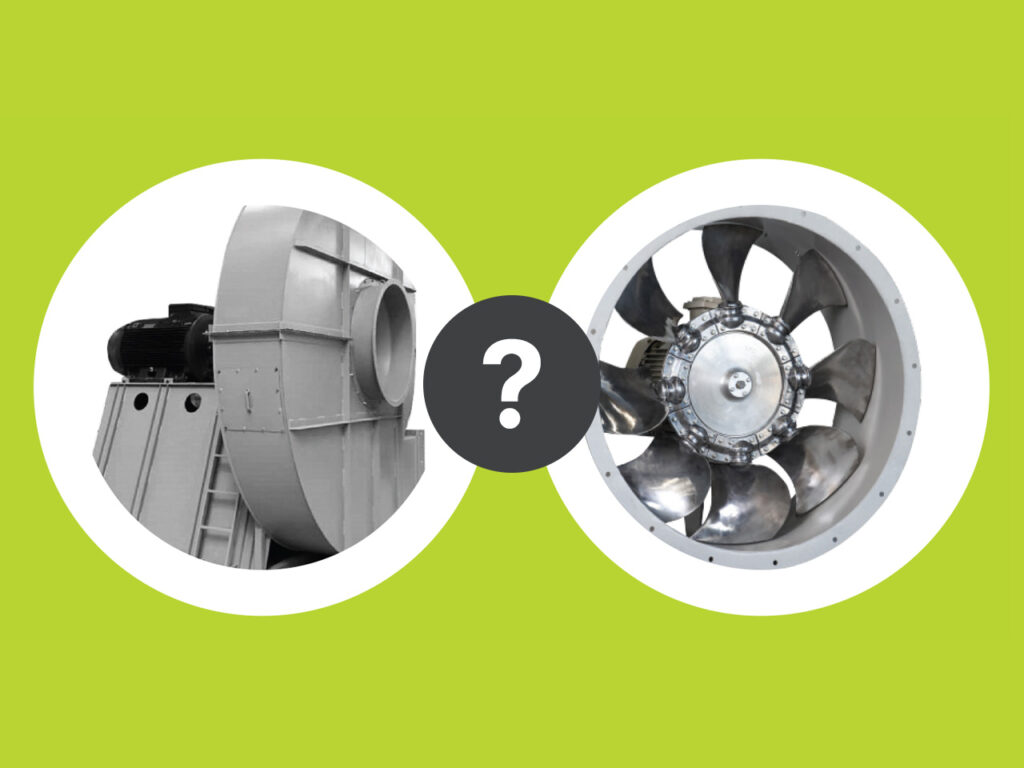
System resistance is the starting point for fan selection. An axial fan moves large volumes of air at low pressure; a centrifugal fan can deliver the required flow against the pressure losses across filters, dampers and long duct runs. This article uses figures from OPTIMISTIC product range to explain the difference and what to check before specifying a fan.
How each fan type works
In an axial fan, air enters and leaves parallel to the axis of rotation. This direct flow path makes the fan efficient at moving large volumes of air when system resistance is low. As static pressure rises, however, the available airflow falls rapidly.
In a centrifugal fan, air enters at the impeller eye, turns through 90° and accelerates radially outwards. The impeller imparts energy to the air, allowing the fan to develop a much higher pressure rise. This makes centrifugal fans a common choice for systems with filters, dampers and extensive ductwork.
OPTIMISTIC’s product range illustrates the difference. Its axial fans develop pressures of up to 1,600 Pa, while its centrifugal fans have a pressure ratio of up to 1.2. At atmospheric inlet pressure, this ratio corresponds to a pressure rise of approximately 20,000 Pa, more than ten times the axial fan figure.
When to choose an axial or centrifugal fan
Choose an axial fan to move large volumes of air against low resistance, for example in general ventilation of industrial buildings, condenser cooling or roof exhaust systems. OPTIMISTIC axial fans cover flow rates of 17,000–80,000 m³/h and power ratings of 4–160 kW. They feature a lighter construction and blades with an optimised aerofoil profile. They are best suited to clean air, since entrained abrasive particles can wear the blades.
Choose a centrifugal fan where system resistance is high. Examples include industrial processes, drying systems and pollution control equipment in which air must pass through scrubbers or filters. Centrifugal fans are better suited to dirty or hot air. For air and process gas service, units are available in carbon steel or stainless steel, with protective coatings for corrosion resistance and power ratings up to 5 MW.
Both types can serve the same installation: axial fans can provide general building exhaust, while centrifugal fans provide local exhaust where filtration requires a higher pressure rise.
In practice, multiple bends, filters or long duct runs increase the static pressure the fan must develop and favour the use of a centrifugal fan.
Axial and centrifugal fans compared
| Criterion | Axial fan | Centrifugal fan |
|---|---|---|
| Airflow path | Parallel to the shaft | Turns through 90°; radial discharge |
| Flow and pressure | High flow, low pressure | High static pressure |
| Efficiency | Best at low system resistance | Best suited to overcoming duct and filter losses |
| Noise | Higher pitch; louder at high speeds | Lower pitch; easier to attenuate |
| Space requirements | Compact; fits in line with the duct | Larger footprint; flexible choice of discharge orientations |
| Dirty or hot air | Better suited to clean air | More robust in these conditions |
| OPTIMISTIC range | 17,000–80,000 m³/h; up to 1,600 Pa; 4–160 kW | Pressure ratio up to 1.2 (fans); up to 5 MW |
The qualitative selection criteria come from a fan manufacturer. Operating ranges are taken from OPTIMISTIC’s product pages (see Sources).
Frequently asked questions
How OPTIMISTIC can help
OPTIMISTIC designs and manufactures axial fans and centrifugal fans and blowers according to customer requirements and tests them at its factory. Its axial fans cover flow rates of 17,000–80,000 m³/h at pressures up to 1,600 Pa. Its centrifugal fans and blowers are designed for higher pressures, with power ratings up to 5 MW. Options include variable-frequency drives and sensors for temperature, pressure and vibration.
Send us required flow rate, total system static pressure requirement, gas type and operating temperature to info@optimistic.pt, and our technical team will be glad to assist and size your fan around your operation envelope.
Sources
- Long, D. (Hartzell Air Movement). Axial vs. Centrifugal Fans: How to Choose the Right One for Your Facility.
- ISO 5801:2017. Fans — Performance testing using standardized airways.
- ISO 14694:2003. Industrial fans — Specifications for balance quality and vibration levels.
- OPTIMISTIC. Axial fans and Centrifugal fans and blowers