

Choosing the right type of compressor can determine the operational efficiency, maintenance costs and reliability of an entire industrial facility. With dozens of possible applications — from petrochemical refineries to green hydrogen facilities — the decision between centrifugal and reciprocating compressors is one of the most important choices an asset manager or process engineer can make.
In this article, we compare both technologies in detail to help you make the right decision.
What is a Centrifugal Compressor?
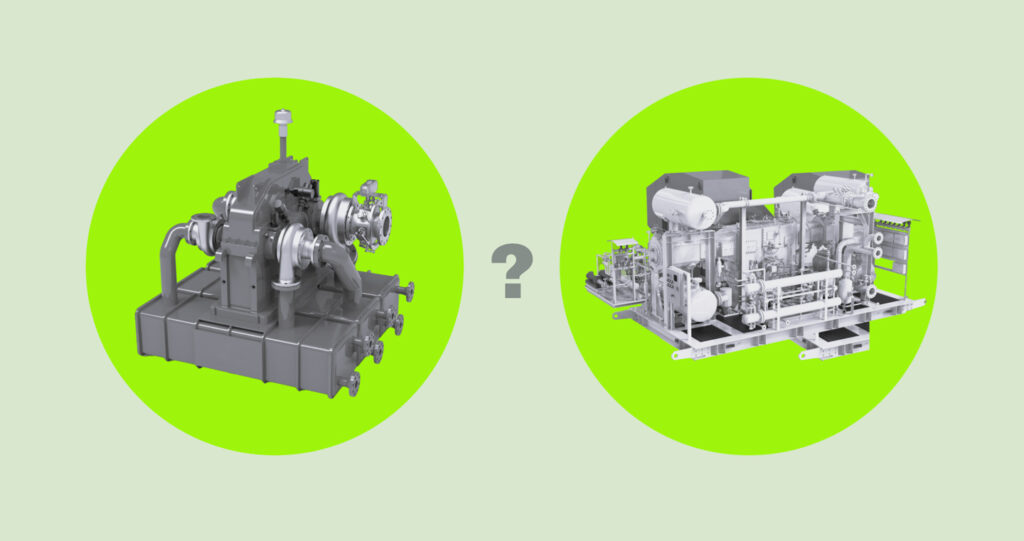
A centrifugal compressor is a continuous-flow machine that increases gas pressure through the centrifugal force generated by a rotating impeller. The gas enters through the centre of the impeller and is accelerated radially, converting kinetic energy into pressure.
These are robust, high-flow machines particularly efficient in applications requiring a continuous supply of compressed gas at large volumes.
Typical applications: Refineries, petrochemical plants, hydrogen production, industrial HVAC systems and large-scale compressed air systems.
What is a Reciprocating Compressor?
A reciprocating compressor uses pistons driven by a crankshaft to compress gas inside a cylinder. Compression occurs intermittently — the piston moves forward to compress the gas and then retracts to admit more gas.
These are versatile machines capable of achieving very high pressures and are suitable for lower or intermittent flow rates.
Typical applications: Oil & gas industry (natural gas compression), industrial refrigeration plants, laboratories and high-pressure applications.
Technical Comparison: Centrifugal vs. Reciprocating
1. Flow Rate and Pressure
Centrifugal compressors are superior when the objective is to move large volumes of gas (high flow rates). Reciprocating compressors excel when very high pressures are required — potentially reaching several hundred bar — with lower flow rates.
- Centrifugal: high flow rate, moderate pressures (typically up to ~70 bar in multistage configurations)
- Reciprocating: very high pressures, lower or variable flow rates
2. Energy Efficiency
Efficiency strongly depends on the operating point. Centrifugal compressors tend to be more efficient when operating close to their design point, but their efficiency drops rapidly outside this range (a phenomenon known as “surge” or “choke”). Reciprocating compressors maintain more stable efficiency across different flow rates.
Technical note: Energy consumption typically represents 70–80% of a compressor’s total lifecycle cost. Selecting the right compressor type for the actual load profile of the facility is essential.
3. Maintenance and Availability
Centrifugal compressors have fewer moving parts in direct contact (no valves or piston rings), which generally translates into lower maintenance frequency and higher operational availability.
Reciprocating compressors require more regular maintenance of valves, piston rings and packing systems, although interventions are usually simpler and more predictable.
- Centrifugal: less frequent maintenance, higher uptime
- Reciprocating: more periodic maintenance, predictable wear parts
4. Gas Compatibility
For clean and dry gases, both technologies perform well. For gases containing heavy components, entrained liquids or particles, reciprocating compressors are generally more tolerant.
Centrifugal compressors are sensitive to variations in gas composition that alter molecular weight, as this directly affects their hydrodynamic behaviour.
5. Installation and Capital Cost
Large-scale centrifugal compressors generally involve higher capital expenditure, but the cost per unit of compressed gas can be significantly lower in continuous high-volume operations.
Reciprocating compressors typically have a lower entry cost for smaller installations.
Summary Comparison Table
| Criteria | Centrifugal | Reciprocating |
| Volumetric flow rate | High | Low to medium |
| Maximum pressure | Moderate | Very high |
| Efficiency at nominal load | High | High |
| Maintenance | Less frequent | More periodic |
| Liquid tolerance | Low | Moderate |
| Capital cost | Higher | More accessible |
| Suitable for hydrogen | Yes (dry H₂) | Yes (high pressure) |
So, Which One Should You Choose?
The answer depends on three key factors: the required flow profile, the necessary discharge pressure and the characteristics of the gas being compressed.
As a general rule:
- Choose a centrifugal compressor if you need to process large volumes of gas continuously, with moderate pressures and minimal maintenance downtime.
- Choose a reciprocating compressor if your application requires high pressure, variable or intermittent flow rates, or if you are working with gases of varying composition.
In many complex industrial facilities, both technologies coexist — centrifugal compressors handle high-volume compression during the initial stages of the process, while reciprocating compressors provide the final high-pressure stage.
Our recommendation: Before making a decision, carry out an analysis of the actual operating point of your installation — not just the nominal design values. Optimistic can support this analysis through its specialised engineering team.
How Optimistic Can Help
Optimistic manufactures and supplies high-quality centrifugal and reciprocating compressors, supported by in-house production capabilities in Portugal and an engineering team specialised in industrial rotating equipment.
In addition to equipment supply, we provide complete repair, predictive maintenance and monitoring services, helping industries maximise the lifespan and efficiency of their compressors.
Contact Optimistic for a technical analysis tailored to your application: info@optimistic.pt