


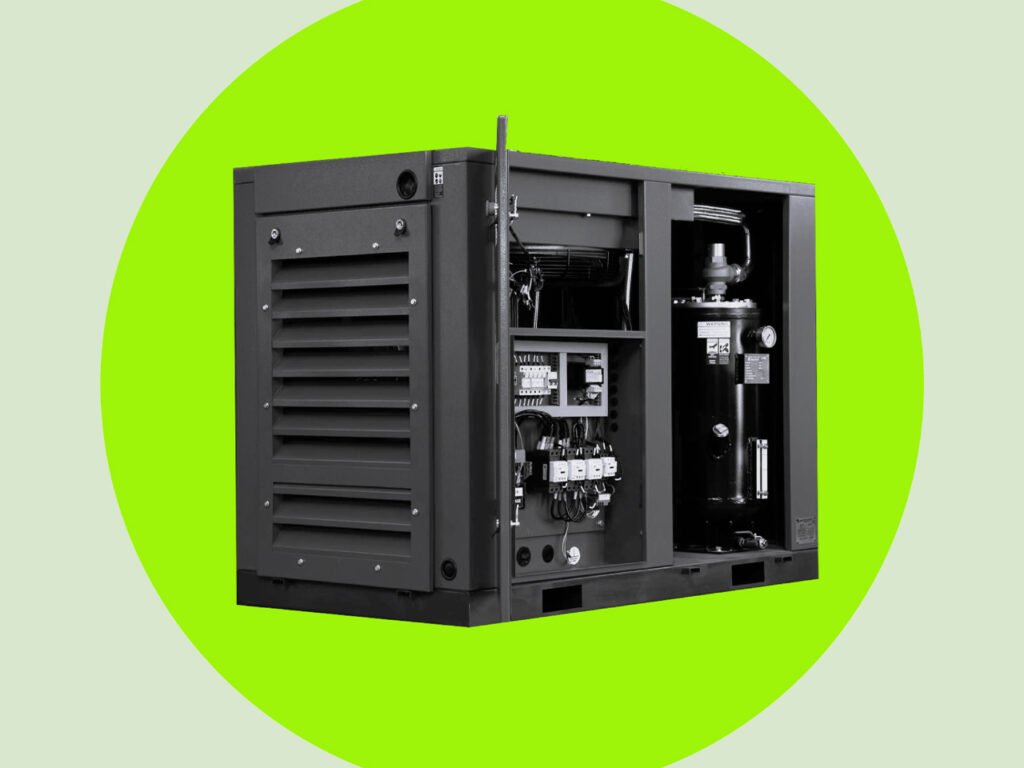
Screw compressors bridge the gap between centrifugal and reciprocating compressors. They handle intermediate flow rates in continuous service and tolerate changes in pressure and gas composition. For process engineers and asset managers, the question is usually which operating conditions favour a screw compressor over the alternatives. This article explains how screw compressors work, when to choose one and where other technologies perform better.
How a screw compressor works
Two intermeshing helical rotors, typically a four-lobe male rotor and a six-lobe female rotor, trap the gas and compress it as it moves along the compression chamber. Compression is continuous and requires neither valves nor pistons. A screw compressor is a positive displacement machine: at a given speed, its volumetric flow rate remains nearly constant as pressure varies.
There are two main types:
- Oil-injected (oil-flooded): The oil seals the rotor clearances and cools the gas, absorbing 70–85% of the heat of compression. This allows a high pressure ratio in a single stage. The oil must then be separated from the discharge gas; residual oil content is typically 1–5 ppm. The oil must also be compatible with the process.
- Dry (oil-free): Timing gears synchronise the rotors so that they do not touch. No oil is introduced into the gas during compression. Discharge temperature limits the achievable pressure ratio; operating experience indicates an upper discharge temperature of about 260 °C.
API 619, which is identical to ISO 10440-1, covers both types in process service. General-purpose air compressors are outside its scope.
When to select a screw compressor
Screw compressors occupy the middle ground between centrifugal and reciprocating machines. The following conditions favour their selection:
- The duty calls for a steady, intermediate flow rate. Oil-injected machines typically handle 400–18,000 m³/h. The crossover to centrifugal compressors generally occurs in the 10,000–20,000 m³/h range.
- The discharge pressure is moderate. Oil-injected machines with vertically split casings can reach discharge pressures of around 50 bar. Dry machines can reach around 40 bar absolute.
- Gas composition varies. Screw compressors are much less sensitive than centrifugal compressors to changes in gas molecular weight and are not subject to surge. They can start on air or nitrogen and then switch to process gas.
- The gas contains entrained liquid or particles. Screw compressors tolerate entrained liquid and gases prone to polymerisation. Under these conditions, reciprocating machines can experience valve and cylinder problems, while centrifugal machines are susceptible to erosion.
- Low maintenance is a priority. With no compressor valves or pistons to maintain, screw compressors offer higher availability than reciprocating machines. A properly specified unit may eliminate the need for a standby machine.
Three limits are worth considering. If the process requires dry, oil-free gas, an oil-injected machine is unsuitable. For light gases at high pressure and low flow, a reciprocating compressor is usually the better choice. In hydrogen service, the pressure ratio of a dry screw compressor is limited to about 2.5:1.
Comparison of screw, centrifugal and reciprocating compressors
| Selection criterion | Screw | Centrifugal | Reciprocating |
|---|---|---|---|
| Typical flow rate | Intermediate (approx. 400–18,000 m³/h, oil-injected) | Intermediate to very high | Low to intermediate |
| Discharge pressure | Moderate (up to approx. 40–50 bar) | Moderate to very high (typically up to 350–400 bar with a radially split casing) | High to very high |
| Variation in gas molecular weight | Tolerant | Sensitive | Tolerant |
| Entrained liquid | Tolerant | Sensitive (erosion) | Sensitive (valves and cylinders) |
| Surge | Not applicable | Requires surge control | Not applicable |
| Maintenance requirements | Low | Low | More frequent |
The figures below are indicative values from the technical literature (see Sources). Always confirm suitability with the manufacturer for the actual gas and operating point.
Frequently asked questions
How OPTIMISTIC can help
OPTIMISTIC works with European manufacturers to package screw compressors in accordance with API 619 and carries out MRT testing at its factory. It supplies oil-free and oil-injected packages for air and process gases, with atmospheric suction pressure, discharge pressures up to 35 barg and power ratings from 5.5 to 1,800 kW.
If your application requires a higher discharge pressure or a different type of machine, see our reciprocating compressors and centrifugal compressors. Visit the screw compressors page or email info@optimistic.pt with your gas composition, flow rate, suction and discharge pressures, and operating duty.
Sources
- Almasi, A. Apply Wet Screw Compressors Wisely. Chemical Processing, 19 set. 2013.
- Nordquist, G., Bielskus, P. e Clayton, R. Dry Screw Compressors in Process Gas Applications Including Maintenance Considerations. Proceedings of the 21st Turbomachinery Symposium, Texas A&M (documento antigo, usado como referência técnica).
- API Std 619 (R2024), adoção idêntica da ISO 10440-1:2007: resumo da norma.
- Danfoss. Using VFDs in refrigeration and cold storage applications.
- Optimistic. Compressores de parafuso.